
- Blue Economy
- Fisheries
- Community
- Q&A
How a Celebrity Chef Learned to Love Farmed and Frozen Fish
To feed a growing population, sustainable seafood advocate Ned Bell is encouraging fellow chefs and seafood consumers to look beyond ‘fresh’ and ‘wild.’
Dear Deeply Readers,
Welcome to the archives of Oceans Deeply. While we paused regular publication of the site on September 1, 2018, we are happy to serve as an ongoing public resource on ocean health and economy. We hope you’ll enjoy the reporting and analysis that was produced by our dedicated community of editors and contributors.
We continue to produce events and special projects while we explore where the on-site journalism goes next. If you’d like to reach us with feedback or ideas for collaboration you can do so at [email protected].
Exploring the impact of overfishing, climate change and pollution and efforts to create sustainable fisheries through innovative reforms and policies.
Follow via RSS
To feed a growing population, sustainable seafood advocate Ned Bell is encouraging fellow chefs and seafood consumers to look beyond ‘fresh’ and ‘wild.’

As the United Nations prepares to begin negotiations next month on a high seas biodiversity treaty, some scientists and advocates say a spate of recent research supports banning commercial fishing in international waters to protect remote ecosystems.

Ann Bucklin
Despite the critical role marine zooplankton play in ocean ecosystems, scientists know little about the tiny species. Ann Bucklin, a professor of marine sciences at the University of Connecticut, describes how her laboratory is changing that.

A new study finds that industrial fishing vessels flying the flags of wealthy nations are catching the majority of the world’s fish, adding to a growing discussion over how food security and sustainable fishing are connected.

With one of the ocean’s iconic predators globally threatened, a shark tagging program off the shores of Long Island is an effort to understand behaviors of young in a marine region where their numbers may be increasing.
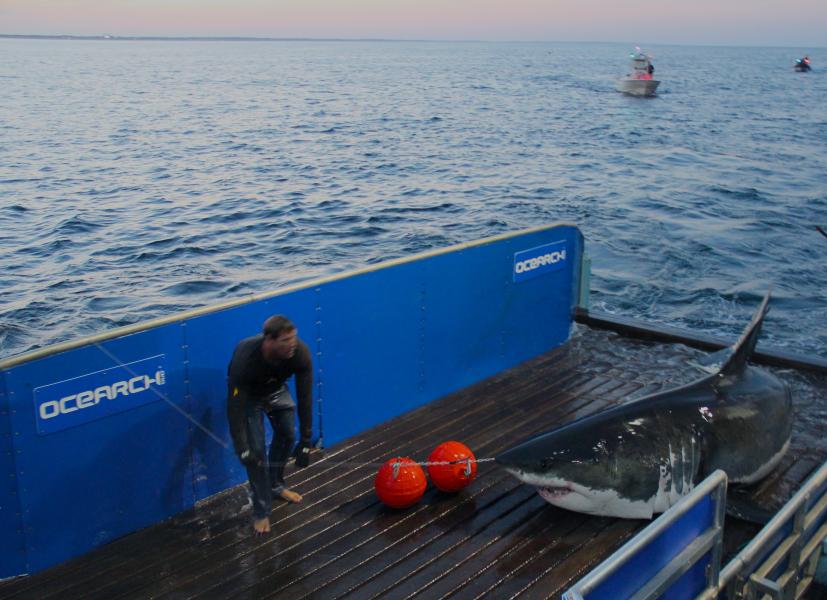
The combination of tagging and social media has helped both scientists and the public engage with the ocean’s most feared predator in new ways. Jim Ware, who has tweeted as Mary Lee – the world’s most famous shark since Jaws – tells Oceans Deeply about his experience.

The Taiwanese government is starting to listen to its critics as it works to improve monitoring of conditions for foreign workers on its large long-distance tuna fishing fleet. But local and international labor advocates say reforms aren’t happening quickly enough.

Near the coast of Japan, the annual spawning ritual of the normally elusive deep-sea creatures attracts the attention of fishers and scientists. Despite years of study, no one fully understands how or why they bioluminesce.

As foreign-owned fishmeal factories proliferate in West Africa to supply feed for overseas aquaculture operations, prices for a key staple of the local diet are skyrocketing and Gambian fishers find it increasingly hard to compete against industrialized trawlers.

With data from 1,800 tropical coral reefs, new research weighs in on an ongoing conservation debate: whether it’s better to preserve marine areas that are still pristine or those that need the most protection.

Researchers say the effects of more frequent and intense weather would hit hardest in developing countries that rely on fishing for livelihoods and sustenance. But few have studied the potential catastrophic impacts on global fisheries – or the potential solutions.

Researchers hope tagging efforts will yield new insights into mantas’ life cycle and behavior, including their migration from what could be the first confirmed nursery for juveniles in the Gulf of Mexico.

Jennifer McHenry PhD Student, Florida State University
Heather Welch Researcher in Ecosystem Dynamics, University of California
Marine mammals, sea turtles and other species don’t always stay within the boundaries of ocean reserves. Two scientists say marine preserves should be designed with enough flexibility to extend protections to where animals migrate.

The future of krill – and all the marine wildlife that feed on them – is uncertain in the changing Southern Ocean. Krill biologist Stephen Nicol says they may be adaptable to climate change, but new technologies need to be deployed to study their enigmatic behavior.

Roberta Elias Deputy Director for Ocean Policy, World Wildlife Fund
Whitley Saumweber Ocean Policy Consultant
We must reorient our ocean management to adapt to new climate realities, say Whitley Saumweber, former ocean and coastal adviser to President Obama, and Roberta Elias of the World Wildlife Fund.

Following Capitol Hill Ocean Week, Oceans Deeply’s Jessica Leber and Kristen Sarri of the National Marine Sanctuary Foundation discuss the ocean and coastal priorities of the Trump administration and Congress.

A hotly debated study that found a big decline in fish populations over the past decade comes as the government proposes to open up some marine protected areas to recreational and commercial fishing.

In India’s Gulf of Mannar, more than a decade of efforts have spurred a slow recovery of coral reefs that protect the coast and feed communities. But climate change has reversed that success.

A coalition hopes to achieve a network of marine protected areas in the vast Southern Ocean by 2020. Earle argues that the health of the planet itself is at stake.

Global Fishing Watch is using satellites to monitor brightly lit fishing vessels at night, adding to its ability to monitor a growing portion of the world’s commercial fleet. The goal: to help crack down on illegal fishing and make seafood more sustainable.

Kimberley Davies Postdoctoral Research Associate, Dalhousie University
The need for new protections for North Atlantic right whales in Canada’s Gulf of St. Lawrence underscore these animals’ dire situation – and how little we still know about them.

On the Greek isle of Santorini, fishers, divers, scientists, government officials and environmentalists have devised their own plan to preserve the marine ecology of the waters surrounding an island dependent on fishing and tourism.

As fishers on Wasini Island began seeing the effects of coral ecosystem degradation, including declining catches, they revived an age-old tradition of conservation to replant and protect their reef.

Oliver Knowles Senior Oceans Campaigner, Greenpeace International
The environmental group and the world’s biggest tuna producer are collaborating to improve working conditions and environmental practices. Now other seafood companies need to join a global effort to make tuna fishing sustainable.

Robert Parker at the University of British Columbia has calculated greenhouse gas emissions from the global fishing industry. He talks about what the data show and why not all fisheries are alike.

Coastal predators are increasingly living in habitats beyond their traditional niches – a sign, a new paper argues, that they may be more resilient than thought.

A lawsuit challenging the Northeast Canyons and Seamounts Marine National Monument could undo a decade of ocean protections. But environmentalists say the Trump administration – which is defending the monument in court – is the bigger threat to the unique ecosystem.

Projects to convert retired oil rigs into artificial reefs are controversial. But advocates and consultants Emily Callahan and Amber Jackson argue this practice provides valuable habitat at a time when natural coral reefs are disappearing.

Jefferson Keith Moore Professor of Earth System Science, University of California, Irvine
Over the next two centuries, warming oceans could trap nutrients at the poles and starve out many of the world’s fisheries, according to a recent study.

The Okeanos Expedition has returned from a 23-day exploration of the deep ocean in the Gulf of Mexico. Scientist Daniel Wagner says that much of what they saw was new to science and could affect management of the Gulf.

Researchers analyzed the environmental impacts of replacing land-raised meat with farmed seafood to feed a burgeoning population and found aquaculture could preserve nearly 750 million hectares. But there could be nutritional tradeoffs.

Lionfish are decimating valuable native species in the western Atlantic Ocean, but spearing the predators hasn’t been enough to slow their spread. Now scientists and fishers are developing traps and other technology to catch the voracious fish en masse.

Claire Nouvian, one of the winners of this year’s Goldman Environmental Prize, has successfully battled to protect marine life from destructive fishing practices.

Scientists recalculated historical catch data to find that bottom trawlers that scrape the seafloor with huge nets may be killing far more fish – and destroying more habitats – than previously thought.

Residents and scientists are working to cull urchins that ravage environmentally important kelp ecosystems. But experience shows that once urchins take over, restoration is difficult and may become even harder as the ocean warms.

Marine scientist Edward Allison says his research shows that in some developing countries, fish farming is not benefiting nutritionally vulnerable communities. That has triggered a backlash from other researchers and the aquaculture industry.

Scientists have identified a ‘biogeographic boundary’ for commercially valuable marine animals in the northwest Atlantic that divides genetically distinct populations of the same species. As temperatures rise, that dividing line is moving north.

Aquaculture proponents view the ocean off Southern California as an ideal place for an emerging industry. The key, new research found, will be to carefully locate facilities to minimize environmental risks and conflicts with other marine uses.

The activist group Greenpeace, which tracked krill fishing vessels near sensitive Southern Ocean habitats, argues that the fishery is putting pressure on an ecosystem already threatened by climate change.

After years of work to bring oysters back, the Chesapeake Bay Foundation found funding and interest harder to maintain, says scientist Chris Moore. So it helped form a new partnership that aims to plant 10 billion oysters by 2025 and grow a bigger oyster-farming industry.
Have a story idea? Interested in adding your voice to our growing community?
Learn more